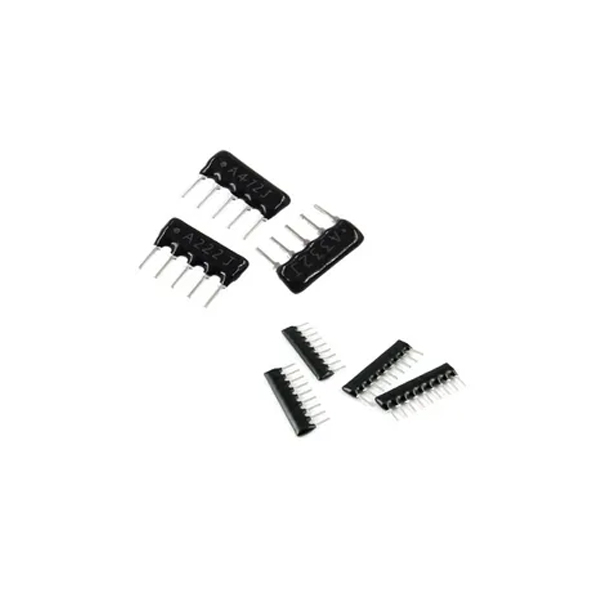
Features:
1. High integration, saving PCB space
An 8P4R (8-pin 4-resistor) chip resistor can replace 4 independent chip resistors, greatly increasing installation density.
2. Excellent parameter consistency
The precision of resistance values and temperature coefficient (TCR) within the same batch and package are highly matched to ensure circuit symmetry.
3. Simplify assembly and reduce costs
Multiple resistors can be welded at once, reducing the number of components, mounting times, and inspection points, making it suitable for automated SMT production.
4. Small parasitic parameters
The internal connections are short, and the equivalent series inductance (ESL) and distributed capacitance are smaller, resulting in better high-frequency/high-speed circuit performance.
5. Various specifications
Encapsulation: Direct insertion SIP (such as 4P2R, 8P4R, 10P8R), SMT SOIC/0408/0612.
Resistance: 1 Ω~10M Ω, accuracy ± 0.1%~± 5%.
Power: Single resistor 0.063W~0.25W.
Applications:
1. Digital circuit pull-up/pull-down: The voltage levels of I/O ports, buses, and button matrices are stable.
2. LED array current limiting: unified current control for digital tubes and indicator light groups.
3. High speed bus terminal: impedance matching of data buses such as DDR/SDRAM to reduce signal reflection.
4. Precision voltage divider/level conversion: a precise voltage divider network for DAC, ADC, and sensor signal conditioning.
5. Level matching and attenuation: signal attenuation and isolation in audio and video circuits.
6. Logic gate array: an auxiliary resistor network around the CPU and FPGA.