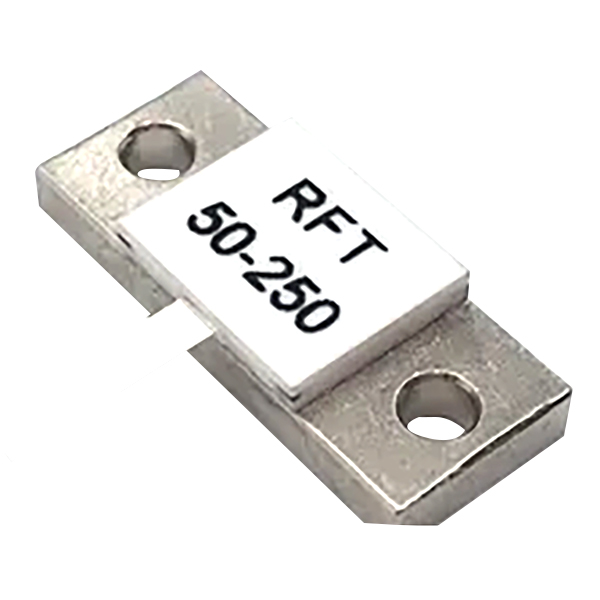
RF Resistors are special resistors designed specifically for high-frequency (RF/microwave) circuits, with the core of maintaining stable resistance, low parasitic parameters, and low standing wave ratio in the MHz~GHz frequency band.
Features:
1. Low parasitic: Extremely small parasitic inductance (L) and capacitance (C), without "misalignment" at high frequencies.
2. Frequency stability: The resistance value changes very little with frequency, and there is no obvious resonance.
3. Impedance matching: commonly used 50 Ω/75 Ω, adapted to the standard impedance of RF systems.
4. Power and accuracy: covering low power (surface mount) to high power (ceramic tube/flange), with high accuracy and low temperature coefficient.
Applications:
1. Impedance matching (core)
Connect 50 Ω RF resistors to transmission lines, antennas, and amplifier ports to eliminate reflections, improve signal integrity, and enhance power transmission efficiency.
2. Dummy Load
During RF equipment testing/no-load, absorb power and replace antennas to prevent signal reflection from damaging the amplifier.
3. Attenuator
Form a π/T type network to reduce signal strength, protect sensitive devices, and adjust link gain.
4. Power divider/coupler
As an isolation/matching component, it ensures the isolation and power allocation accuracy of each port.
5. RF filter
Control bandwidth, suppress spurious and noise, and improve signal quality.
6. Bias and stability
Provide DC bias for transistors and amplifiers to suppress self excitation and stabilize operating points.
7. Testing and Measurement
Used for calibration and sampling of power meters, network analyzers, and signal sources.