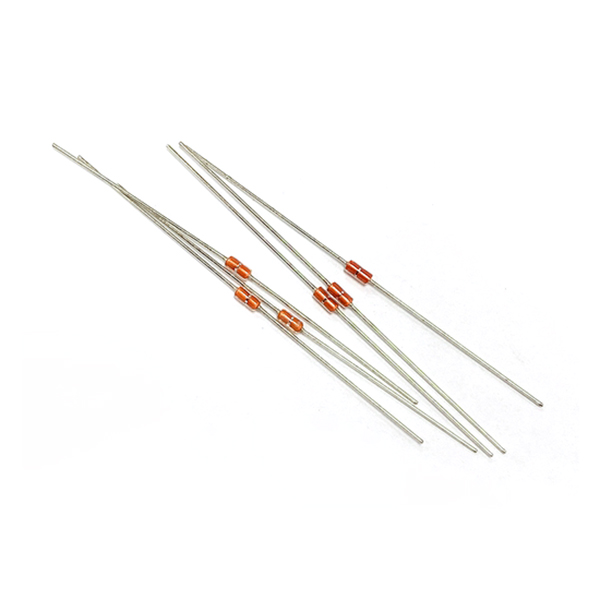
Features:
1. High sensitivity
For every 1 ℃ change in temperature, the resistance change rate can reach -3% to -7%, which is much higher than that of platinum resistors (PT100 is about 0.385%).
2. Fast response speed
Small size, low thermal inertia, response time up to milliseconds, and the ability to quickly track temperature changes.
3. Nonlinear characteristics
Resistance and temperature exhibit a nonlinear negative exponential relationship, which needs to be linearized through a lookup table or formula (Steinhart Hart equation).
4. Small size and low cost
Diverse packaging options (SMT, lead, glass sealing), high cost-effectiveness, suitable for large-scale applications.
5. Good stability
Ceramic structure, anti-aging, moisture resistance, strong chemical stability, long service life.
Applications:
1. Temperature measurement and control (temperature measuring NTC)
Home appliances: temperature control and measurement for air conditioners, refrigerators, rice cookers, electric water heaters, and coffee machines.
Automotive electronics: water temperature, oil temperature, intake temperature sensors.
Consumer electronics: temperature monitoring (BMS system) for mobile phones, laptops, and lithium battery packs.
Medical equipment: electronic thermometer, incubator.
2. Surge current suppression (power type NTC)
Power circuit: Connected in series with the input circuit of the switching power supply, frequency converter, and UPS. When in cold state, the resistance is high, which suppresses the high current surge at the moment of startup; After heating, the resistance decreases without affecting normal operation.
3. Temperature compensation
Electronic circuits: Compensate for parameter drift caused by temperature changes in components such as transistors, integrated circuits, and quartz crystal oscillators.
4. Overheating protection
Motor, transformer, LED driver: Monitor temperature, trigger protection circuit in case of overheating to prevent equipment from burning out.