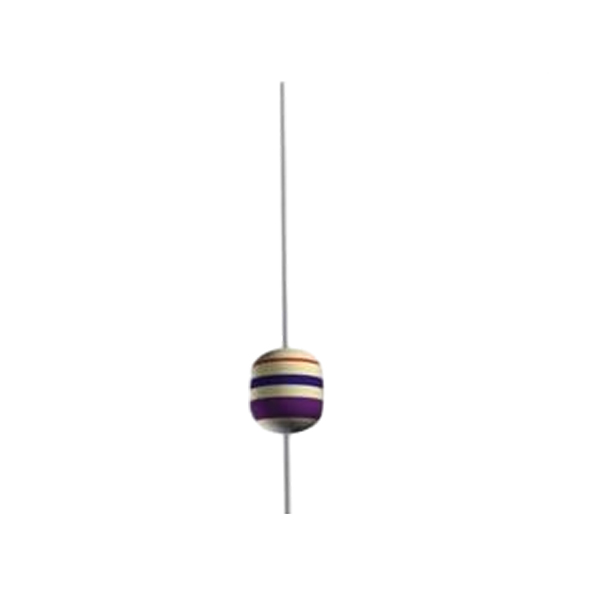
Axial Leaded Laser Multi Layer Ceramic Capacitor (MLCC), also known as Axial Leaded Laser Multi Layer Ceramic Capacitor, is a type of monolithic capacitor that belongs to the MLCC variant with axial leads and has a cylindrical like appearance.
Features:
1. Packaging and appearance
Axial lead: Two pins extend from the center of both ends of the cylinder, consistent with the resistor package, suitable for through-hole installation.
Laser printing: clear parameters, solvent resistance, high temperature resistance, and not easily worn.
Standard size: Commonly available axial packages such as 0805, 1206, 1210, etc.
2. Electrical characteristics (inheriting the advantages of MLCC)
Capacity range: 0.1pF~2.2 μ F.
Temperature characteristics:
C0G (NP0): Ultra stable, low loss, suitable for high frequencies.
X7R: Large capacity, medium stability, -55 ℃~+125 ℃.
Y5V: Large capacity, poor stability, suitable for ordinary circuits.
Rated voltage: 50V~630V.
3. Machinery and Environment
Epoxy encapsulation: moisture-proof, earthquake resistant, high mechanical strength.
Good heat resistance: suitable for wave soldering and reflow soldering.
High reliability: good insulation and long service life.
4. Advantage utilization
Easy to weld and repair: suitable for manual welding and repair, more friendly than SMT.
Tape packaging: supports large-scale production of automatic insertion machines.
Lead stress relief: The pins can buffer PCB vibration or thermal expansion and contraction stress, and have better shock resistance than surface mount MLCC.
Applications:
1. Traditional/industrial equipment: old instruments and meters, power supplies, industrial control boards, automotive electronics (requiring high reliability and earthquake resistance).
2. Power circuit: decoupling, bypass, filtering, energy storage (such as DC-DC, LDO peripherals).
3. Signal circuit: coupling, DC isolation, resonance, timing (C0G material).
4. Repair/Prototype: Electronic Repair DIY、 Laboratory prototype (convenient for manual welding).
5. High vibration scenarios: automotive, aviation, military (seismic requirements).