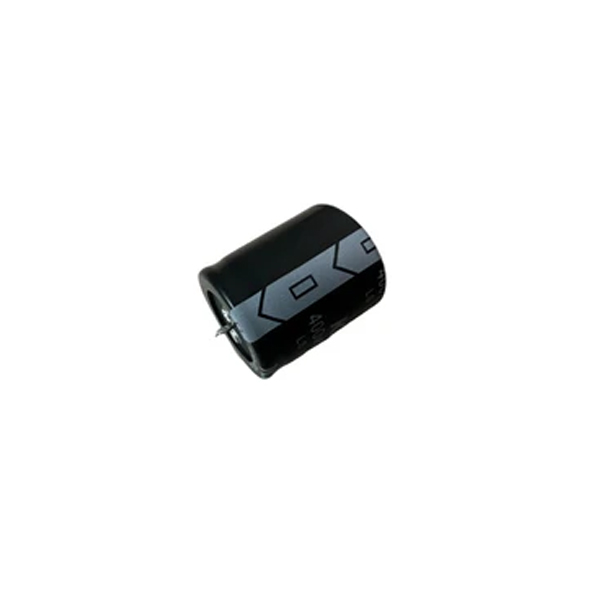
Core structure: Composed of anode aluminum foil, cathode aluminum foil, electrolytic paper (interlayer), and electrolyte (liquid/solid) wound together.
Working principle: The surface of the anode aluminum foil is electrochemically oxidized to form a very thin layer of aluminum oxide (Al ₂ O3) dielectric film, and the electrolyte acts as the cathode for conductivity.
Features:
1. Advantages
Extremely high capacity density: The capacity range is extremely wide (1 μ F~1F), and the capacity far exceeds MLCC and thin film capacitors in the same volume.
Low cost: cheap raw materials, mature technology, and the highest cost-effectiveness.
Wide voltage range: rated voltage from 6.3V to 500V+, suitable for high and low voltage circuits.
Polarity: It is necessary to distinguish between positive and negative poles. Reverse connection can cause a significant increase in leakage current, heat generation, and even explosion.
Self healing (liquid): When there is a slight breakdown, the electrolyte can repair the oxide film and restore insulation.
2. Disadvantages
Poor frequency characteristics: High frequency impedance (high ESR), not suitable for high-frequency circuits.
Limited lifespan: Liquid electrolyte is prone to evaporation and drying up, and its lifespan is greatly affected by temperature (halving for every 10 ℃ increase).
Large leakage current: Compared to MLCC, the leakage is more obvious and not suitable for high-precision circuits.
Larger volume: The large capacity model has a much larger volume than MLCC.
Applications:
1. Power circuit (most important)
Filtering: In switch mode power supplies, adapters, and PC power supplies, filter out rectified voltage ripples.
Energy storage: DC Link for UPS, frequency converter, and inverter, buffering instantaneous energy fluctuations.
2. consumer electronics
Power boards for household appliances such as televisions, refrigerators, and air conditioners.
Signal coupling/decoupling of audio amplifiers (large capacity ensures low-frequency signals pass through).
3. Industry and Automotive
Motor drive, welding machine, industrial frequency converter.
Automotive ECU, onboard power supply, LED headlight driver.
4. Lighting and others
LED driver power supply, energy-saving lamp ballast.
Camera flash (instantaneous high current discharge).